Why your kid ditched that new toy in 10 minutes (it's not the toy)
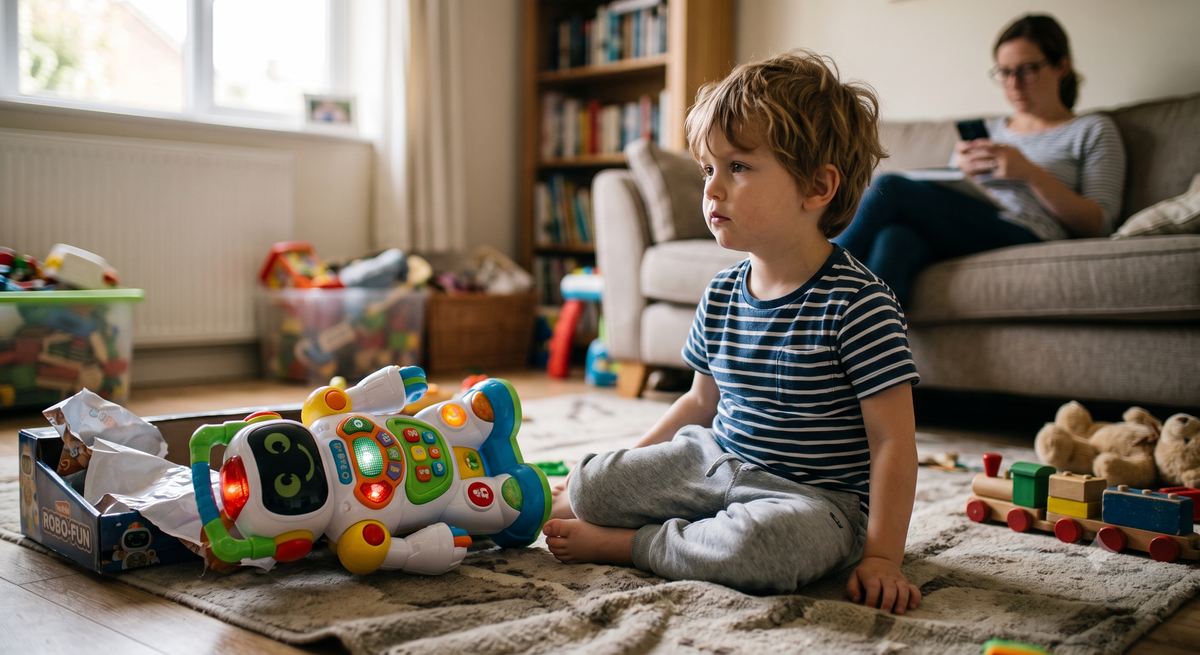
You spent real money on it. You read the reviews. You imagined a whole quiet Sunday.
Your child played with it for nine minutes and went back to asking for the iPad.
Before you decide they "just don't like toys" — they do. What usually goes wrong isn't the toy. It's the first ninety seconds.
A screen never needs an invitation
A tablet opens with a bright noise and something already happening. It does the starting for your child. A busy board, a puzzle, a set of paints — these just sit there, politely, waiting to be understood.
For a four-year-old, that gap between seeing a thing and knowing what to do with it is where most new toys die. Not from boredom. From not knowing where to begin.
The ninety-second fix
Sit on the floor and start playing with it yourself. Don't explain it. Don't demonstrate. Don't say "look what this does!" Just begin, quietly, as if you'd forgotten they were there.
Undo one buckle. Slide one puzzle piece. Dip the brush.
Children are drawn to whatever an adult is genuinely absorbed in. Within a minute or two most will come over and take it off you — which is exactly what you want. They didn't need instructions. They needed a way in.
Then leave. That's the part parents skip. Once they've taken over, get up and go do something else in the same room. Your leaving is what turns it into their play instead of an activity you're running.
Give it a home at eye level
A toy in a box on a high shelf is a toy your child has to ask permission for. Most won't bother.
Put one toy out, on the floor or a low table, where they'll walk past it. Rotate what's out every week or two and put the rest away. Four toys in view beats twenty in a bin — fewer choices, more actual playing, and toys they'd lost interest in come back feeling new.
Expect the slow start
The first few days with a new toy are often the worst ones. They'll poke at it, do it wrong, get frustrated, wander off. That's not rejection, it's the boring middle bit before something becomes a favourite.
The toys our customers tell us about a year later — the ones that survive house moves and get handed down — almost never had a dramatic first day.
The short version
- Start playing with it yourself, without narrating
- Hand it over and walk away
- Keep it out and at their height
- Rotate what's on display; hide the rest
- Give it a week before deciding it failed
None of this makes screens disappear. It just means the other option is easy to reach — which, most afternoons, turns out to be enough.
Ninety seconds of your attention will beat an hour of nagging. Sit down, start, and leave.